
Why Time Management Decides Your NEET 2026 Rank?
For most aspirants, time management for NEET is the invisible factor that separates a good score from a great rank. You may know the concepts, solve PYQs regularly, and revise NCERT multiple times, yet still struggle to finish the paper on time with clean accuracy. The reason is simple: NEET is not just a knowledge test; it is a three‑hour performance test where every minute and every decision counts.
In those 180 minutes, you must handle pressure, choose questions smartly, control negative marking, and manage your OMR bubbling without panic. That’s why learning how to attempt NEET 2026 paper with a clear, rehearsed system matters as much as learning formulas and facts. With a proper plan, you can avoid common traps like getting stuck on one Physics numerical for five minutes, doing OMR in a hurry at the end, or blindly guessing when the clock is ticking down.
This guide will walk you through a practical NEET 2026 time management strategy that you can test in mocks and then repeat on the final exam day. You will see how to divide 180 minutes wisely, how to go section‑wise for maximum score, and how to use OMR techniques and psychological tricks to stay calm and accurate under pressure. Along the way, we will naturally touch four deeper themes: section‑wise attempt strategy, slow‑writer‑friendly approaches, ideal time split for PCB, and OMR discipline – each of which can grow into a separate detailed blog for you later.
1. Understanding the NEET 2026 Time and Pattern Reality
Before you fix time management for NEET 2026, you must understand what the exam is really asking from your mind and body in three hours. To clearly understand the latest structure, question distribution, and marking scheme, you can refer to this detailed breakdown of the NEET 2025 Exam Pattern and Age Limit – What You Must Know, which explains the official format in depth.
From a practical student’s point of view, this means your NEET 2026 time management strategy cannot treat all questions or all sections identically. You must decide in advance: which subject will you attempt first, how many minutes you can afford per section, and which questions you will leave for later without feeling guilty. This is where learning how to attempt NEET 2026 paper in a structured three‑round approach becomes powerful:
- First round: answer only easy and sure questions, move fast, and build momentum.
- Second round: attack moderate or slightly longer questions where you have a fair idea.
- Third round: attempt selected tough or confusing questions only if time allows and your mind is stable.
This logic is also the base for a future child blog on “How to Attempt NEET 2026 Paper Section‑Wise for Maximum Score”, where you can go deeper into Biology‑first vs Physics‑first debates, subject‑wise confidence, and different profiles of students. By understanding the pattern and the psychological demand of moving quickly without panic, you prepare yourself not just to finish but to finish with fewer silly mistakes. Background clarity is the foundation on which the rest of your time plan stands.
2. Core Strategy: How to Attempt the Paper and Use Time Intelligently
A strong time management for NEET 2026 system combines question selection, pacing, and risk control. You don’t just “do all questions in order”; you run a clear process. A widely used and effective approach is: Biology → Chemistry → Physics, with specific time caps per section and two passes per subject.
2.1 Section‑wise attempt flow
When planning how to attempt NEET 2026 paper, many mentors suggest solving Biology first because it is high‑weightage and less calculative. A typical structure looks like:
- Biology: 45–50 minutes, focus on direct NCERT lines and diagrams.
- Chemistry: 50–55 minutes, theory first, then numericals.
- Physics: 60–65 minutes, conceptual and formula‑based questions first, heavy numericals later.
- Buffer and OMR: 15–20 minutes.
Within each subject, your NEET 2026 time management strategy can follow “Pass 1 – Pass 2”: answer only direct and sure questions in Pass 1, mark tricky ones with a symbol, then revisit them in Pass 2 if time permits. This avoids getting emotionally stuck early in the paper.
2.2 Risk rules and negative marking
Smart time use also means smart risk control. A simple rule set can protect your marks and improve your overall time management for NEET 2026. To understand how negative marking can silently reduce 40–60 marks and how to prevent it, you can read this detailed guide on Negative Marking in NEET 2026: How to Avoid Silly Mistakes and Save 40–60 Marks. A simple rule set:
- Attempt only when you can eliminate at least 2 options.
- If you have no clue, skip – marks lost to negative marking are harder to recover.
- Fix a maximum number of “educated guesses” you will allow, based on your mock analysis.
This system leads naturally to a dedicated child blog, “How to Attempt NEET 2026 Paper Section‑Wise for Maximum Score”, where you can later give chapter‑wise suggestion orders, per‑section micro‑plans, and PYQ integration ideas. For now, see this as your operational blueprint that you will repeatedly test in weekly mocks, gradually refining it until it feels natural and automatic.
3. Managing Time as a Slow Writer or Average Student
Many aspirants feel that time management for NEET 2026 is harder because they write slowly, calculate slowly, or need more time to read questions. The good news is that “slow” is often just “unstructured and under‑practised”; with the right drills and strategy, even average students can safely finish the paper. This is where a separate angle on NEET 2026 time management strategy for slow writers becomes useful – the core idea of your future child blog, “NEET 2026 Time Management Strategy for Slow Writers and Average Students.”
3.1 Practical adjustments for slow writers
Some practical changes that help:
- Choose Biology first to gain fast early marks and confidence.
- Use a strict “60–90 second rule”: if a question doesn’t move in 60–90 seconds, mark it and move on.
- Practice writing calculations with shorter steps and symbols rather than full sentences.
- Reduce over‑reading; underline keywords (not whole sentences) in the question.
3.2 Focused practice blocks
Break your practice into time‑boxed sprints that mirror real exam stress:
- 30‑minute Biology sprint: aim for 30–35 questions from mixed chapters.
- 30‑minute Chemistry sprint: mix theory and small numericals.
- 30‑minute Physics sprint: only formula‑based questions with moderate calculations.
Over weeks, this converts slow writers into more efficient solvers, and your NEET 2026 time management strategy begins to feel natural rather than forced. This entire philosophy is a bridge to your second child blog, where you can give dedicated drills, sample schedules, and motivational examples of average students who improved speed without sacrificing accuracy.
4. Ideal Time Split: Dividing 180 Minutes for PCB
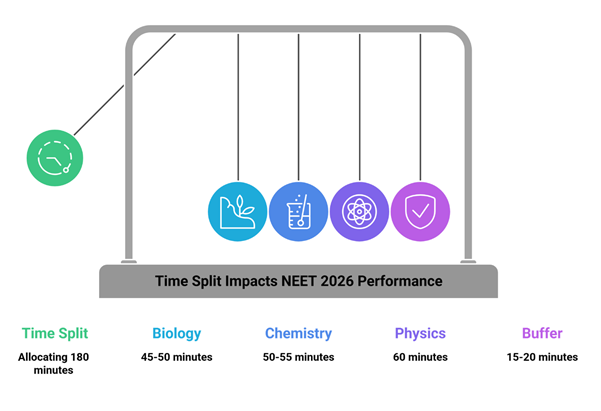
A central piece of time management for NEET 2026 is deciding how to allocate those 180 minutes across Physics, Chemistry and Biology. There is no universal “perfect” split, but there are sensible starting points you can adapt after mock analysis. The most commonly recommended structure is:
- Biology: 45–50 minutes
- Chemistry: 50–55 minutes
- Physics: 60 minutes
- Buffer/OMR: 15–20 minutes
This section connects directly with your third child blog, “How to Divide 180 Minutes in NEET 2026: Ideal Time Split for PCB.” Students often waste time by improvising during the exam instead of following a pre‑decided template.
4.1 Why Biology first helps
Attempting Biology first lets you:
- Secure a large chunk of marks early.
- Build momentum with relatively faster questions.
- Reduce anxiety before entering Chemistry and Physics.
However, if Physics is your strongest subject, mock test experiments might show a different order working better for you. That’s exactly the type of personalised twist you can later explain in the child blog.
4.2 Tracking and optimising your personal split
To refine your NEET 2026 time management strategy, track after every mock:
- Actual time spent per subject vs planned.
- Number of questions left unattempted in each subject.
- Accuracy in first‑round vs second‑round questions.
Using this data, you can gently shift 5–10 minutes between subjects and make the plan truly your own. The more you respect this 180‑minute framework in practice, the easier it becomes to finish the real paper on time with better accuracy.
5. OMR Filling, Tools and Technology: Where Marks Are Silently Lost
Even with excellent time management for NEET 2026, poor OMR discipline can quietly destroy 20–30 marks. Many students mis‑bubble, skip rows, or leave the OMR to the last three minutes and panic. A professional approach treats OMR as seriously as solving the question paper itself. This is the heart of your fourth child blog, “NEET 2026 OMR Filling and Bubble Strategy to Avoid Time Waste and Errors.”
5.1 Smart OMR strategies
Some tested strategies you can describe and later expand:
- Fill OMR in blocks of 10–15 questions to balance speed and safety.
- Always use a good black ball‑point pen; avoid gel pens.
- Keep one finger on the row while bubbling to avoid shifting lines.
- Reserve the last 10–15 minutes only for final OMR checks and small revisits, not for filling 50 unanswered bubbles.
5.2 Tech and tools that support practice
Technology can quietly support time management for NEET 2026:
- OMR practice sheets and scanning apps that show your OMR accuracy.
- Online mock platforms that simulate the 3‑hour timer and provide section‑wise analytics.
- Simple stopwatch or timer apps to run 30‑minute sprints and learn pacing.
With these tools, you don’t just know how to attempt NEET 2026 paper in theory; you experience it repeatedly under timed conditions until your brain and hand both adapt. When you later write the child blog, you can include screenshots, sample OMR templates and practice routines to make it even more actionable.
6. Staying Calm While the Clock Ticks
No NEET 2026 time management strategy works if your mind collapses under pressure. Anxiety leads to overthinking straightforward Biology questions, silly sign mistakes in Physics, and careless OMR errors. That’s why genuine time management for NEET 2026 is as much about managing your mind as it is about managing minutes.
6.1 Micro‑strategies inside the exam hall
Some small but powerful tactics:
- Start with a short breathing routine before you open the question booklet.
- Use a “10‑question rhythm”: after every 10 questions, take a 10‑second pause, reset, and continue.
- If you hit a difficult cluster of questions, consciously move ahead instead of fighting them.
- Remind yourself that leaving 10–15 questions is often better than randomly guessing all of them.
These habits support the logical framework of how to attempt NEET 2026 paper and protect you from emotional decisions driven by fear of the clock.
6.2 Mock tests as mental training
Every full‑syllabus mock is a rehearsal not just of knowledge, but of your mental script for the exam day. In each mock, deliberately practice:
- The exact order of sections you plan to use.
- Your 180‑minute split.
- Your OMR block‑filling method.
- Your rules for when to skip and when to make an educated guess.
Over time, you create a stable NEET 2026 time management strategy that feels familiar and safe, reducing panic on the real day. This mental rehearsal is what ultimately helps you finish the paper on time with high accuracy, instead of feeling surprised or overwhelmed when the clock starts.

Make Time Your Ally, Not Your Enemy
In the end, time management for NEET 2026 is not a magical talent; it is a skill you deliberately design, practise, and master. When you understand the pattern, set a clear 180‑minute framework, and refine it through mocks, the exam stops feeling like a race you are losing and starts feeling like a system you know how to run. You’ve seen how section‑wise planning, slow‑writer‑friendly strategies, ideal time splits, and OMR discipline all come together into one coherent NEET 2026 time management strategy that you can rely on during the actual paper.
Your next steps are simple: test this approach in practice tests, track your timing and accuracy, and make small adjustments until you find a pattern that fits your strengths. As you deepen each area in upcoming dedicated blogs – how to attempt NEET 2026 paper section‑wise, strategies for slow writers, perfect 180‑minute division, and OMR mastery – you will build a complete ecosystem of habits that protect your marks on exam day.
If you treat time as a partner instead of a threat, the NEET 2026 paper becomes less of a blur and more of a sequence of planned moves. With calm execution, disciplined practice, and a proven structure, you won’t just finish the paper; you’ll finish it with the kind of accuracy that pushes your rank into a safer, higher zone.
FAQs
1. How can I start improving time management for NEET 2026 if I am already late in preparation?
Begin by adding one timed section practice every day instead of only full‑length tests. For example, solve 45 Biology questions in 40 minutes, then gradually bring it down to 35 minutes. Combine this with weekly full‑length mocks where you strictly follow your planned time management for NEET 2026 and review where you lost minutes. Over 4–6 weeks, your speed and confidence will noticeably improve.
2. What is the safest NEET 2026 time management strategy for average students?
Average students should use a simple, repeatable structure: Biology first, then Chemistry, then Physics, with a fixed time split and clear rules for skipping stuck questions. This NEET 2026 time management strategy emphasises easy and sure questions in the first pass, then moderate ones, while limiting risky guesses. Regular mock analysis will show where to shift 5–10 minutes if a subject is consistently lagging.
3. How to attempt NEET 2026 paper if I panic during Physics?
If Physics triggers anxiety, don’t start your paper with it. Begin with Biology to collect marks and calm your mind, then move to Chemistry and finally to Physics. When you reach Physics, apply the 60–90 second rule: if a question doesn’t move after that, mark and skip. This way you still attempt a good number of Physics questions while protecting time for easier ones.
4. How many questions should I realistically attempt in NEET 2026 to get a good score?
The ideal attempt count depends on your accuracy in mocks, not on a fixed number. If your mock analysis shows 85–90% accuracy, you can afford to attempt more questions; if accuracy is low, it is safer to attempt fewer but more carefully selected questions. Your time management for NEET 2026 should be tuned to support your personal attempt‑accuracy balance instead of copying someone else’s target.
5. How should I manage OMR filling without wasting time in NEET 2026?
Choose a consistent OMR method and practise it in every mock. Many students prefer filling OMR after every 10–15 questions or section‑wise, plus keeping the last 10–15 minutes for a final check. Use a good ball‑point pen, keep one finger on the row to avoid shifts, and never leave 40–50 bubbles for the last few minutes. This approach protects both your time and your hard‑earned marks.