

Knowing this effective study is not about filling every hour with books. The real difference comes from what you do after learning a topic, especially when you forget it or make mistakes. The NMC has finalized an updated NEET (UG) 2026 syllabus for preparation.
How to Study Effectively for NEET with a Simple Study Cycle?
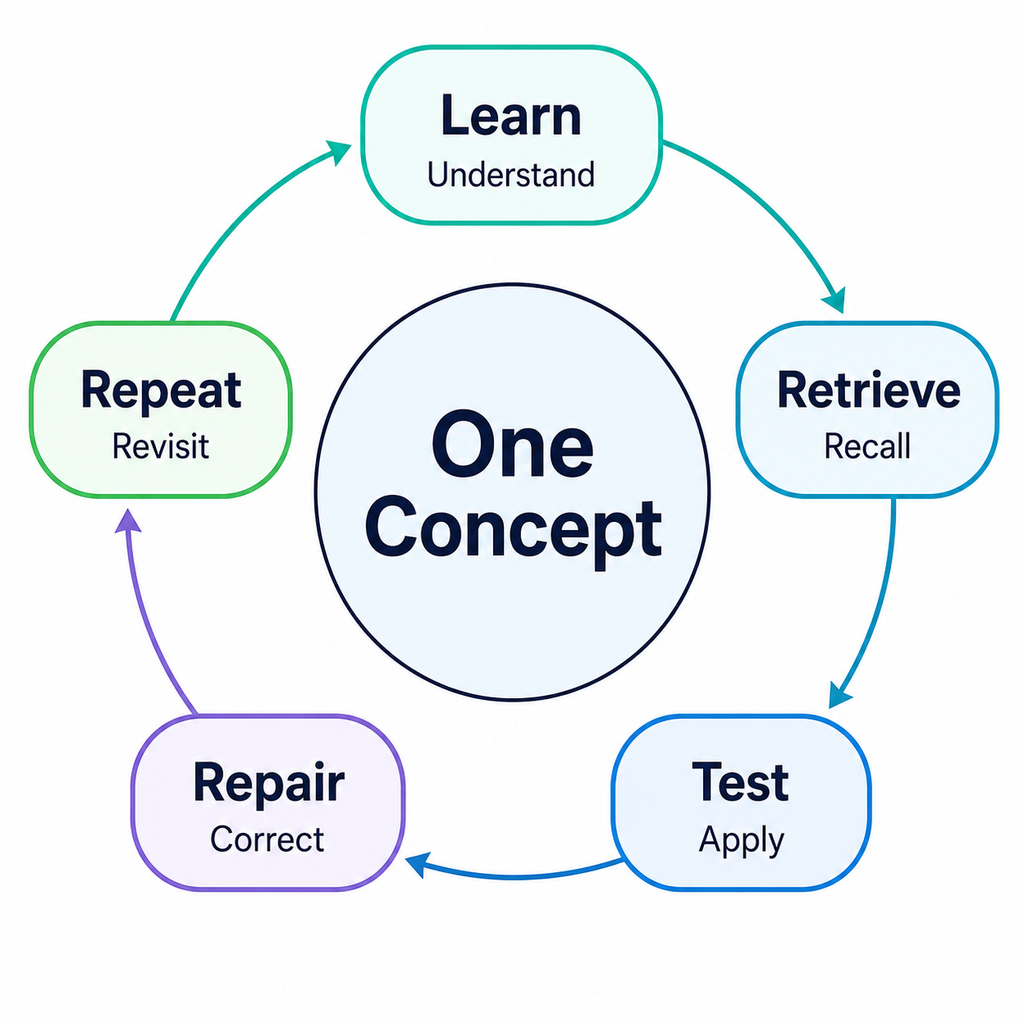
Instead of jumping from chapter to chapter, take one concept through this cycle:
Learn → Retrieve → Test → Repair → Repeat
Start with learn. Understand the idea before trying to memorize it. In Biology, connect the topic with a process or diagram. In Physics and Chemistry, understand why a formula or reaction works.
Then move to Retrieve. Close the book and bring the idea back from memory. An active recall technique can be as simple as explaining the topic aloud, redrawing a diagram, or writing key points without checking notes.
Test Whether You Can Use What You Learned
Once you can recall the idea, solve a small set of questions. A focused test can quickly show whether the concept is really clear.
This is where mock test analysis helps. Look beyond the score. Check questions you got wrong, guessed, or took too long to solve.
For many students, this is where how to study effectively for NEET becomes practical. A test should not only tell you your score. It should show you what to fix next.
Repair the Mistake Before Moving On
When you find an error, do not just mark it and continue. Ask why it happened.
Was the concept unclear? Did you forget a fact? Was it a calculation mistake or rushed reading?
An error correction method turns that mistake into a clear action. Relearn the weak point, solve a few similar questions, and test it again later.
Shrie Shrie Academy’s NEET preparation supports this process through concept teaching, regular tests, question discussions, error analysis, and progress tracking.
Repeat What You Fixed
Come back to the topic after a gap. A spaced revision schedule helps corrected concepts stay active instead of disappearing until final revision.
You do not need a perfect timetable. You need a cycle you can repeat.
Choose one chapter today. Learn one concept, recall it without notes, test it, repair one mistake, and return to it later. That is better than simply counting hours.
Should every subject follow the same cycle?
Yes, but the balance changes. Biology often needs more recall. Physics and Chemistry need more application practice.
What if I keep making the same mistake?
Go back to the reason behind it. Repeated errors usually need a deeper concept review, not more random questions.
When should I repeat a corrected topic?
Revisit it after a short gap and test yourself again instead of only rereading notes. Need help turning your study hours into a clear preparation routine? Speak with Shrie Shrie Academy’s academic team about structured NEET preparation in Erode.
Also read: From Learning to Remembering: How to Study Effectively & Revision Tips for Exams