
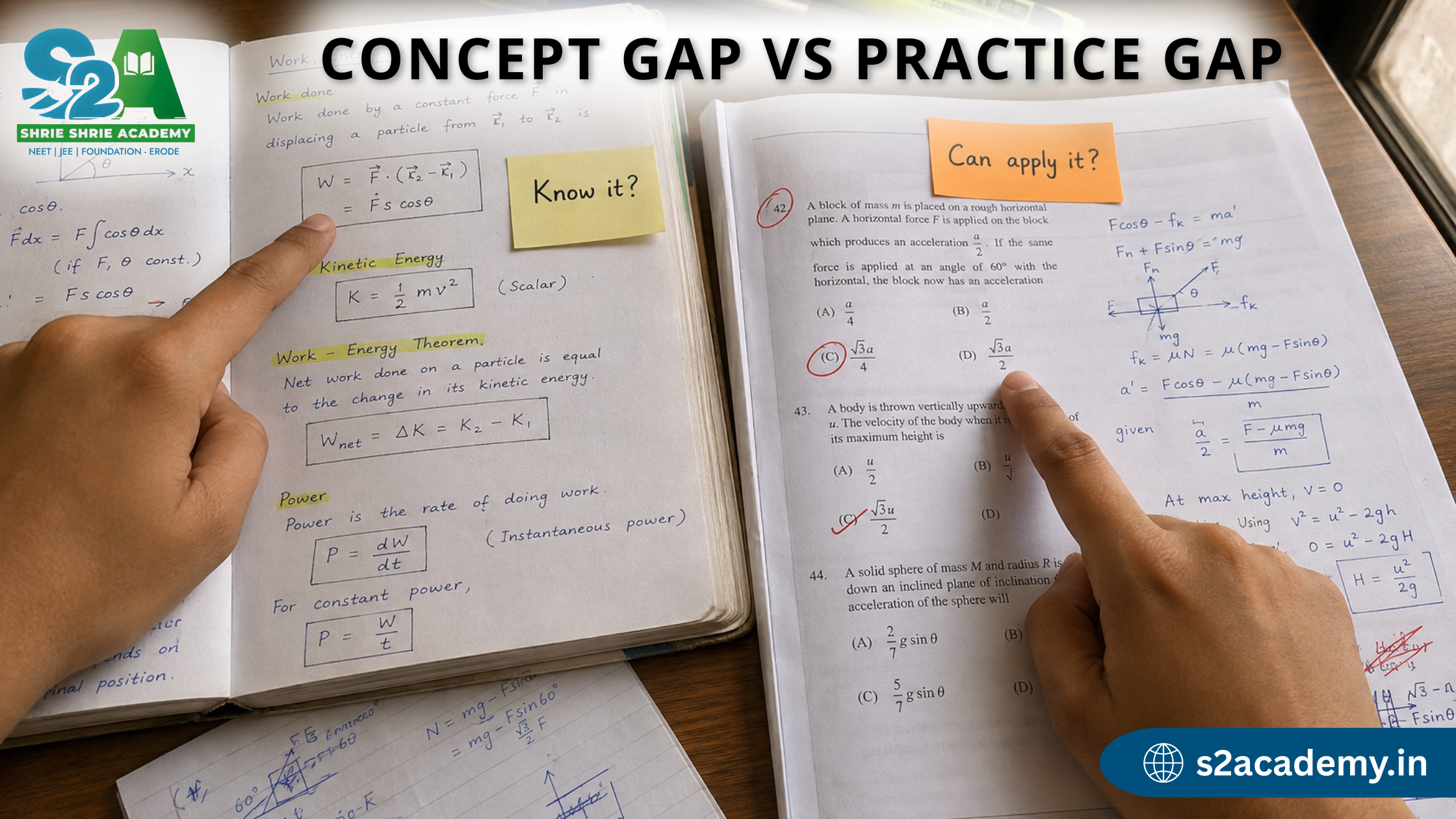
A concept gap means you cannot reliably explain or recall the idea behind a question. A practice gap means you understand the idea, but struggle to apply it independently. Knowing the difference between a concept gap vs practice gap matters because each needs a different correction. More questions cannot repair missing understanding. Re-reading alone cannot build flexible problem-solving. Shrie Shrie Academy (S2 Academy) uses concept classes, practice, regular tests, question-paper discussion, and error analysis as part of its academic methodology.
What does each weakness actually look like?
A concept problem usually appears before the solution begins. The student may forget a principle, confuse definitions, or need notes to explain the topic. A practice problem appears after the idea is understood. Difficulty starts when the question changes format, combines concepts, or requires choosing a method.
| Check | Concept issue | Practice issue |
| Explain without notes | Difficult | Usually possible |
| Solve a direct question | Inconsistent | Usually possible |
| Handle a new variation | Difficult | Often inconsistent |
| First correction | Relearn | Varied practice |
Consider Physics. A student may correctly state Newton’s second law but struggle when several forces act together. That suggests an application problem. If the student cannot explain net force itself, the foundation needs attention. A useful mock test diagnosis therefore looks for repeated patterns, not one wrong answer.
Concept gap vs practice gap: try this 5-minute check
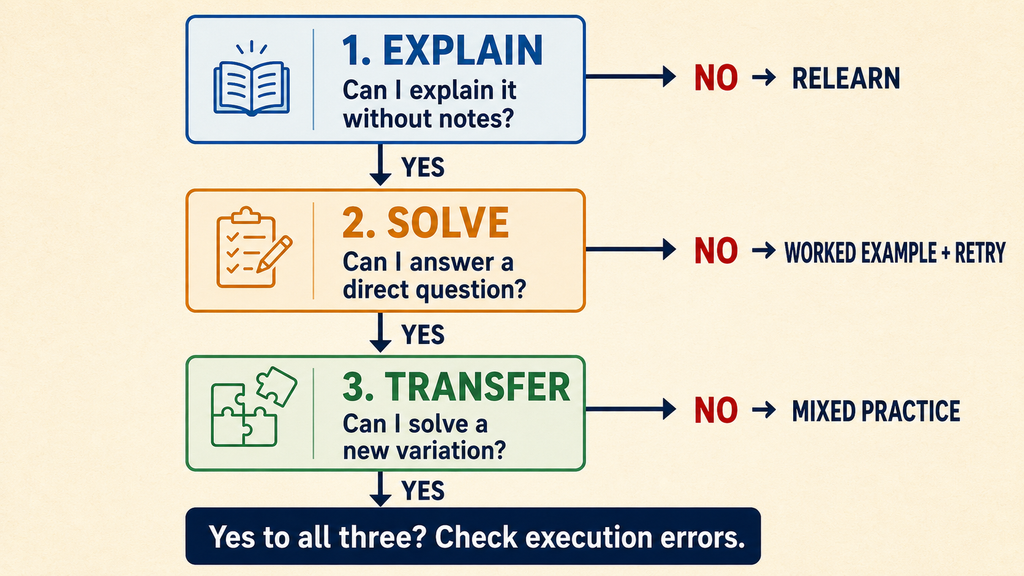
Choose one chapter where you recently lost marks. Keep the solution closed.
- Explain: State the main principle, formula, or mechanism aloud.
- Solve: Attempt one familiar question without hints.
- Transfer: Attempt an unfamiliar variation using the same principle.
Failure at Step 1 points towards understanding. Passing Step 1 but struggling later points towards application. However This chapter weakness analysis is more useful than simply saying, “I am weak in Physics.” The U.S. What Works Clearinghouse recommends helping students monitor and reflect on problem-solving. It also supports exposure to multiple solution strategies.
Match the correction to the actual weakness
For a concept problem, stop repeatedly reading the chapter. Close the book and retrieve the idea from memory. Explain it aloud. Check what you missed. Correct that part and retrieve it again later. A review indexed by PubMed on Testing enhances learning reports that retrieval through testing can improve retention compared with studying alone.
For a practice problem, study one worked solution carefully. Ask why each step was chosen. Then solve several varied questions without copying the method. Research on Repeated testing produces superior transfer of learning relative to repeated studying also found benefits for transferring learning to new questions. Use error pattern review to separate knowledge errors from method, calculation, and timing errors.
S2 Academy’s Foundation programme for NEET/JEE focuses on conceptual learning. The Integrated programme for NEET/JEE connects board preparation with concepts, practice, and testing.
What should you record after the next test?
Use this simple C-P-E Review:
- C — Concept: Could I explain what the question was testing?
- P — Practice: Did I understand it but fail to apply the method?
- E — Execution: Did I know both, but lose marks through timing, reading, calculation, or question selection?
Execution matters. Not every wrong answer proves that a chapter must be relearned. Instead use student performance tracking across two tests. If the same error category repeats, address it before rebuilding the entire timetable.Parents can also change the post-test conversation. Instead of asking only, “What was your mark?”, ask:“Which type of error repeated, and what will you change before the next test?”
Continue with The Student Who Studies 6 Hours a Day and Still Gets the Same NEET Score for the wider performance-diagnosis framework.
FAQ
Does every low NEET/JEE score mean concepts are weak?
No. Marks can also fall through application difficulty, calculation mistakes, poor question selection, or time management.
How many mistakes should a student analyse?
Look for a pattern across several questions or tests. One isolated mistake is usually not enough for a conclusion.
Should I relearn the whole chapter if application is weak?
Usually, no. First confirm that the foundation is sound. Then target varied questions and the methods causing difficulty.
Bottom Line
A concept gap vs practice gap should not receive the same correction. Diagnose the repeated pattern, correct the specific weakness, and test it again.
If the pattern remains unclear, Explore our Classes with S2 Academy for a focused academic discussion.
Related Posts
Why Do NEET Scores or JEE Percentiles Keep Swinging After Every Test? Coming Soon