
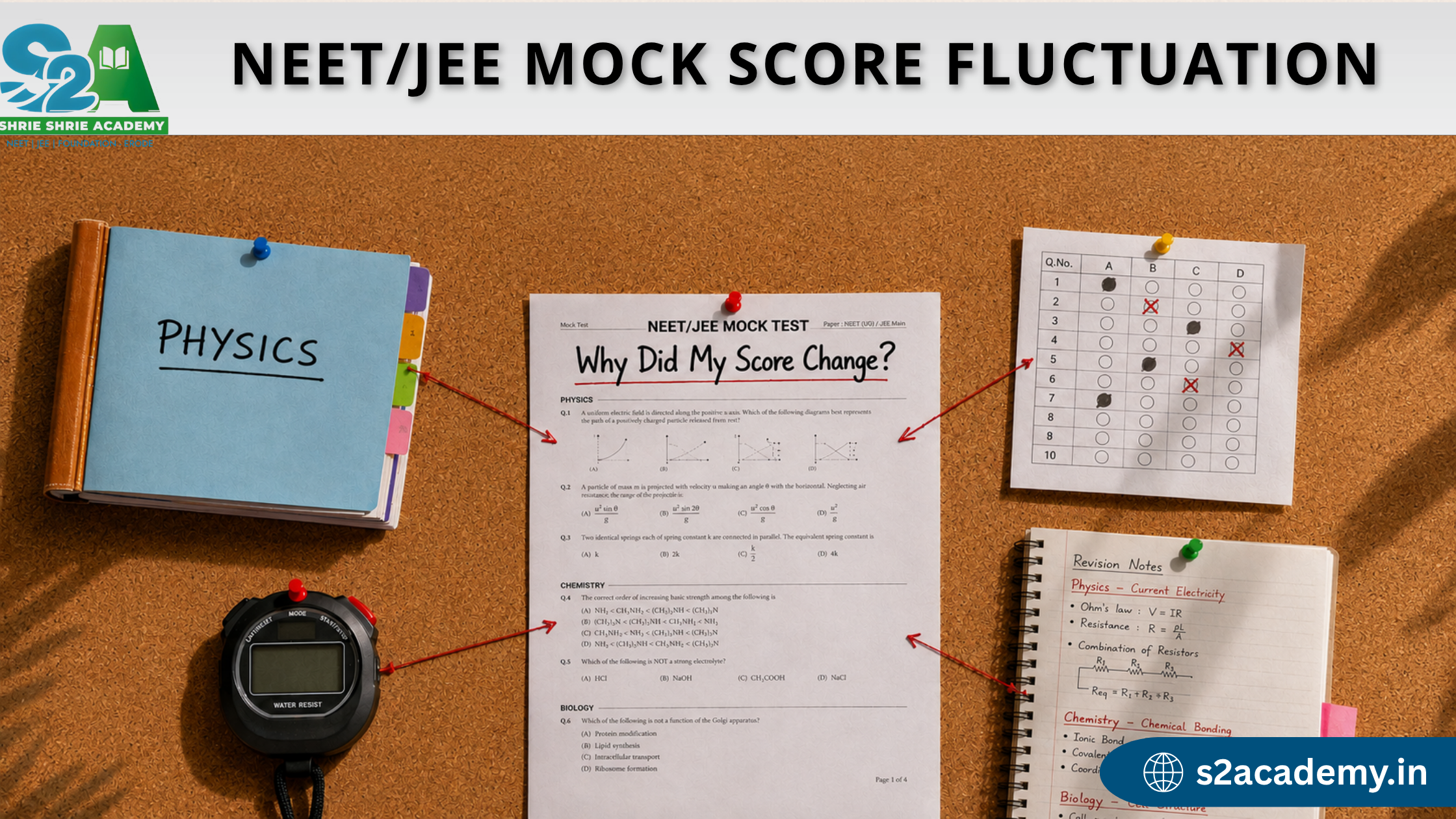
A student may score well in one mock and then drop in the next. That can feel discouraging. However, mock score fluctuation does not always mean preparation has become weak. In many cases, the score changed because the paper changed, the revision mix changed, or the student handled the paper differently.
At Shrie Shrie Academy (S2 Academy), tests are useful only when students move beyond the total mark and understand the pattern behind it.
A changing score becomes meaningful only when you ask:
What changed in the paper? What repeated in my mistakes?
Why can NEET/JEE mock scores change?
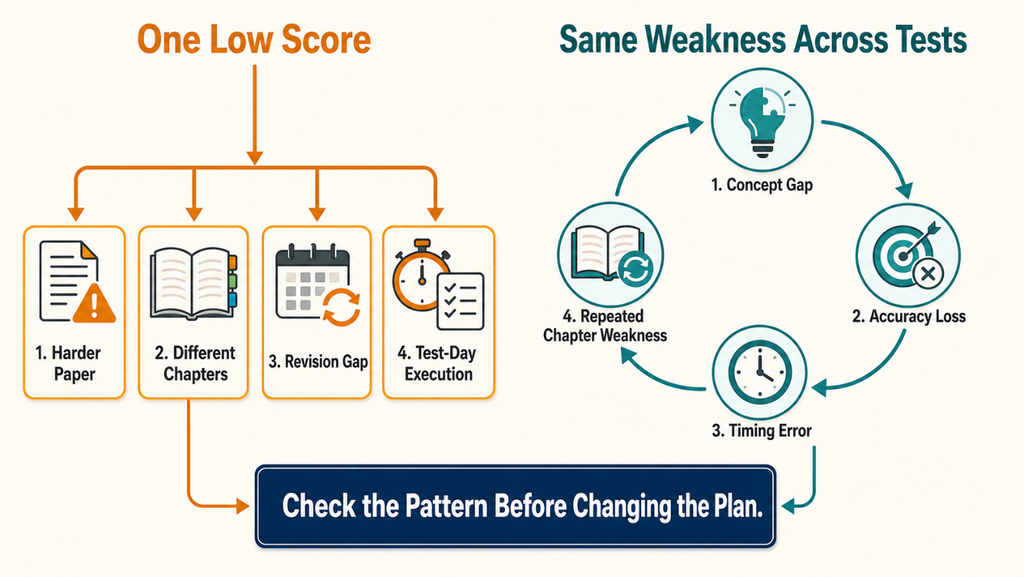
No two mock papers are exactly alike. One paper may contain recently revised Biology chapters, while another may contain older Physics topics or more multi-step Chemistry questions. As a result, test difficulty variation can affect marks even when the student’s overall preparation is similar.
Sometimes the issue is not difficulty alone. A student may lose marks because of rushed guesses, poor question selection, incomplete revision, or weak recall in one chapter. This is why one total score should never be treated as the full diagnosis.
When is score change normal, and when is it a warning sign?
A single low mock is information. The same weakness repeating across several mocks is a pattern. For example, one poor Chemistry score may come from a chapter coverage effect if the test heavily sampled topics the student had not revised recently. That is different from losing marks in electrostatics across three separate Physics tests.
This distinction matters because many students overreact after one bad paper. Instead of rebuilding the entire timetable, they should first ask whether the problem was temporary or repeated.
CBSE’s competency-based assessment approach also supports using assessment as a tool for diagnosis rather than as a number alone.
When to worry
- One poor mock = observe carefully
- Same chapter weakness repeating = correct it
- Same timing/calculation mistake repeating = fix execution
What should students track after every mock test?
Students do not need a complicated system. They only need a simple review method that shows patterns clearly. Use accuracy trend analysis across at least three tests instead of reacting to one score.
Track these five things after every mock:
- total attempts and correct answers,
- repeated weak chapters,
- common mistake types,
- time lost during the paper,
- one correction for the next mock.
The National Test Abhyas initiative from NTA also emphasises mock-test analytics, speed, accuracy, time management, and improvement through repeated testing.
How should students respond to mock score fluctuation?
After every paper, use a simple C-P-E Review:
- C — Concept: Did I understand the chapter?
- P — Practice: Did I know it, but fail to apply it?
- E — Execution: Did I know it, but lose marks through timing, reading, or calculation?
This helps students separate real academic problems from avoidable paper-handling mistakes. A concept issue may need focused revision. A practice issue may need more varied questions. Exam execution errors may need better timing and question selection. Students can also use the S2 Academy blog library and explore the Integrated NEET/JEE programme if they want board-aligned NEET/JEE support.
FAQs
1. Does one low mock mean preparation is declining?
No. One low score may come from chapter mix, difficulty, or poor execution in that paper.
2. When should parents pay closer attention?
Parents should look more carefully when the same chapter gap or avoidable error appears repeatedly across multiple tests.
3. Should every mock score be compared directly?
Not by marks alone. Compare the score along with chapters tested, question difficulty, and error pattern.
Bottom Line
Mock score fluctuation is not the real problem. The real problem is failing to understand why the score moved. When students compare the paper, track repeated mistakes, and correct one clear issue at a time, the next test becomes more useful. If families want programme-related guidance, they can use the S2 Academy enquiry page.
Also Read:
https://s2academy.in/wp-admin/post.php?post=8937&action=edit