
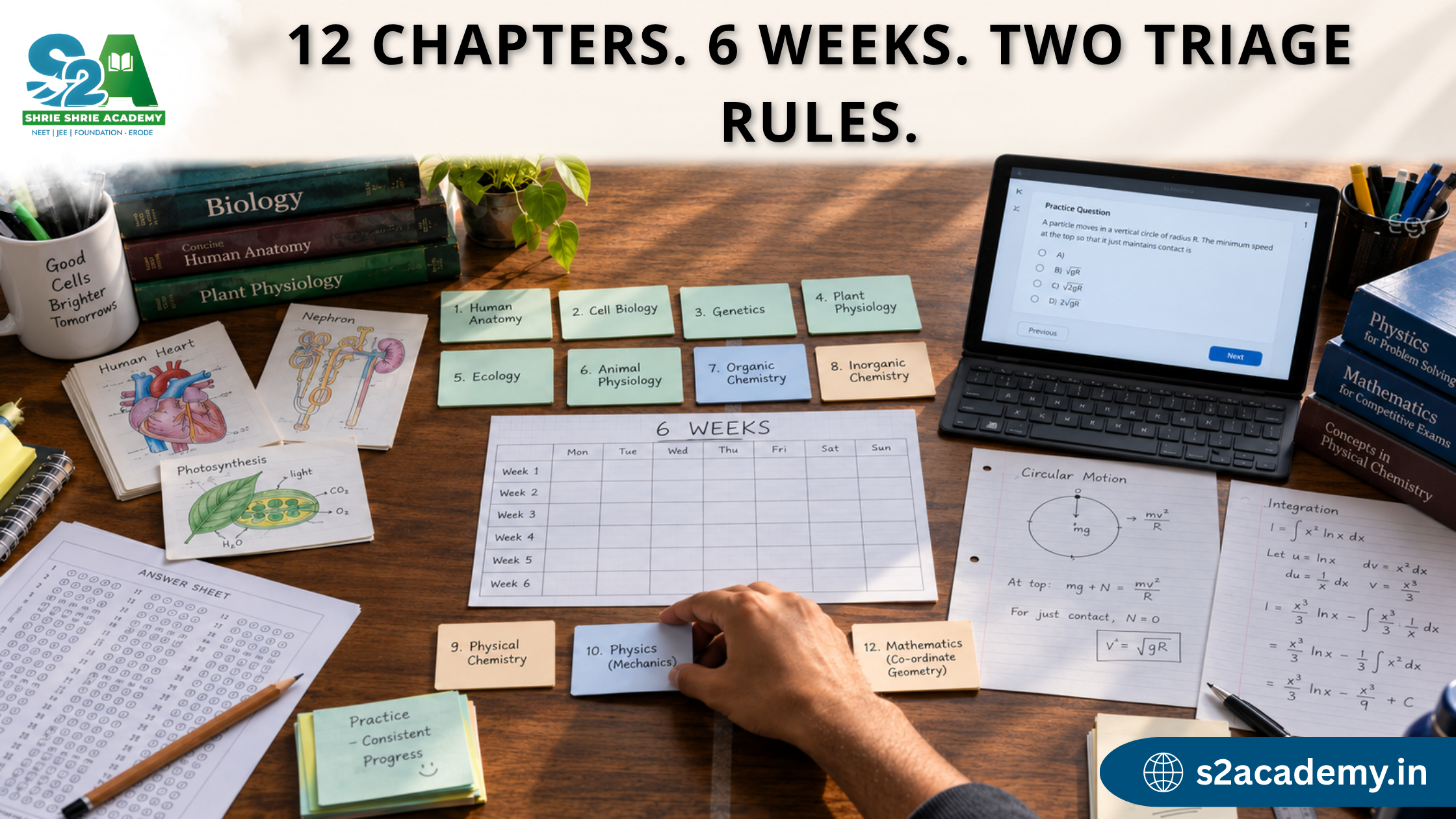
Twelve weak chapters, six weeks left, and two different entrance exams. Giving every chapter equal revision time can waste precious preparation hours. NEET demands accuracy, syllabus coverage, and careful attempts under negative marking. JEE also requires strong prerequisite concepts and multi-step problem-solving. At Shrie Shrie Academy (S2 Academy), the starting question is simple: Which chapter deserves your next study hour?
Why does NEET need a different rescue order?
NEET 2026 uses 180 compulsory questions in 180 minutes. Biology carries 360 of 720 marks. Physics and Chemistry carry 180 each. Wrong answers attract minus one mark under NTA rules.
That changes NEET revision priority. Repeated recall errors, option confusion, or risky attempts may deserve earlier repair than a difficult topic attempted rarely. Use the official NMC syllabus as the boundary. Compare several recent tests first.
Why is JEE more dependency-sensitive?
JEE Main Paper 1 gives Mathematics, Physics, and Chemistry equal marks. It includes MCQs and numerical-value questions, with negative marking in both sections. A JEE recovery strategy needs another question: does this topic support later problems?
Weak algebra can damage coordinate geometry. Weak vectors can disturb mechanics. A missing prerequisite can reappear inside multi-step questions. That is why weak chapters cannot be ranked only by last week’s marks.
Weak chapters: use a 2×2 rescue map
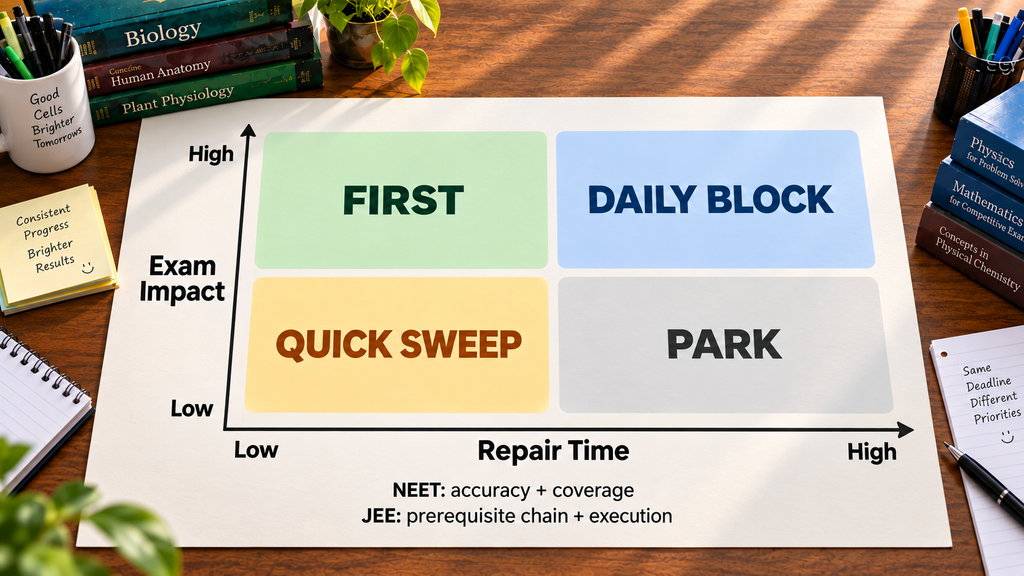
Place each chapter on two axes: exam impact and repair time.
High-impact, fast-repair topics go first. High-impact, slow-repair topics get a daily block. Low-impact, fast-repair topics become short sweeps. Low-impact, slow-repair topics can wait. Estimate impact using mock error analysis, syllabus relevance, repeated mistakes, and prerequisite dependence. Avoid generic chapter-weightage charts without reliable data.
10-minute checkpoint
Write all 12 topics. Circle four repeated across recent papers. Mark which can improve through one focused revision cycle. Choose two from that overlap for tomorrow.
“In preparing for battle I have always found that plans are useless, but planning is indispensable.” — Dwight D. Eisenhower.
Retest before you declare a chapter fixed
A repaired chapter is not one you reread. It is one you can retrieve and apply under test conditions. Use a delayed quiz, mixed questions, or a timed section. Retrieval-practice research supports testing after learning instead of relying only on repeated restudy.
That makes a six-week study schedule adaptive. If the same error returns, keep the topic active. If performance stabilizes, move attention elsewhere. The Retrieval Practice Consistently Benefits Student Learning can be best to read.
Key Takeaways
NEET triage should protect accuracy, coverage, and recurring recall weaknesses. JEE triage should also protect prerequisite chains and multi-step execution.
For both exams: rank, repair, retest, then move.
Bottom Line
With weak chapters, equal time rarely creates equal value. The order should reflect exam structure, repeated errors, prerequisite importance, and realistic repair time.
S2 Academy’s Integrated Programme for coordinated board and entrance preparation addresses both demands. Its personal mentoring and progress-tracking approach keeps the next correction visible.
FAQ
Should I skip low-priority topics completely?
No. Park them temporarily, then revisit them after higher-impact gaps stabilize.
How many topics should I repair each week?
Only as many as you can revise, practise, and retest properly.
Can parents help without increasing pressure?
Ask which error is repeated, what gets corrected next, and when it will be retested.
Browse the S2 Academy NEET and JEE preparation blog library for related guidance. Then Book Counselling with S2 Academy to build a realistic correction order.